
Showing posts with label SED 406. Show all posts
Showing posts with label SED 406. Show all posts
Monday, April 21, 2014
Why should we care about Potholes
Hey fellow classmates. I didn't think to leave my thoughts on how I feel my lesson went. . .I don't think the "skeleton" of the plan was very strong. That said, I always would like a second chance to do a better job. I need to figure out a format in which to present the information, it was disorganized. I do like the topic, but this plan needs work. So please leave your comments regarding my manner, whether I gave you enough time to think, etc. here. (Seriously, don't hold back I would really appreciate your help). And sorry about the pink marker Caroline!

Wednesday, April 2, 2014
Observation #2, Backwards Lesson Plan
SED 406
Prof. Kraus
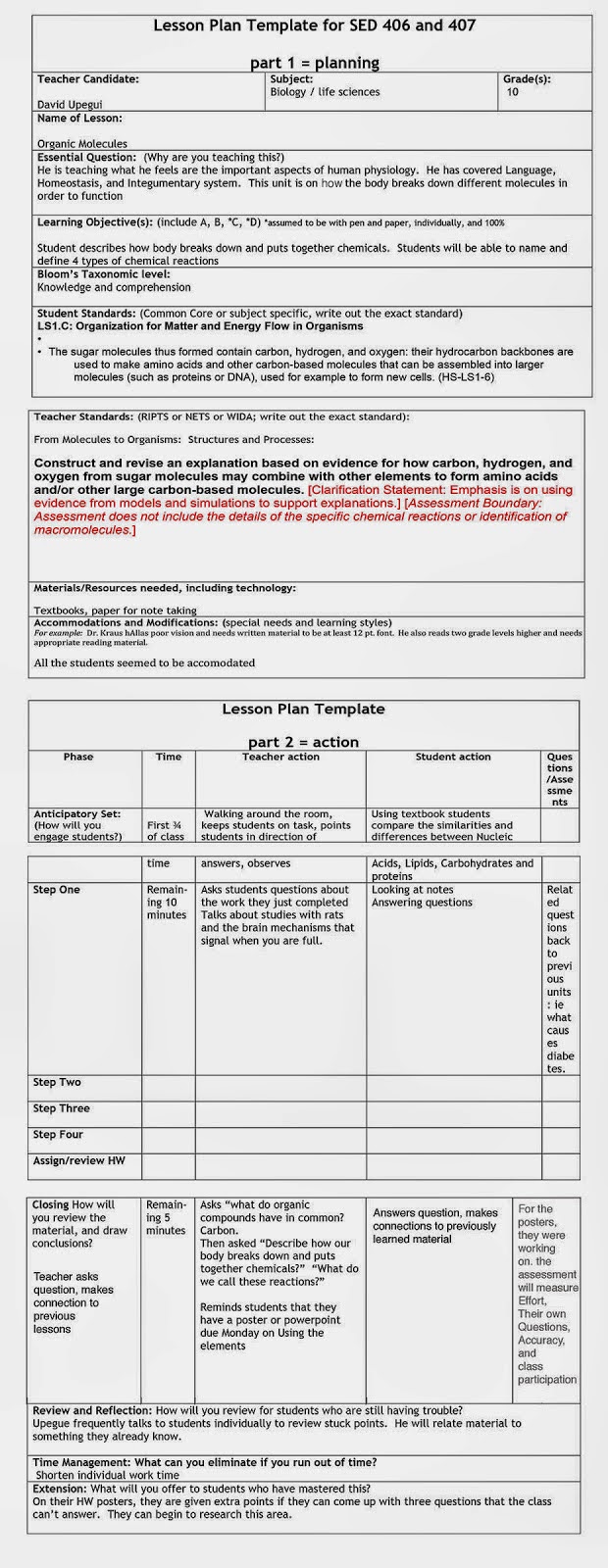
CFHS observation, backwards to a lesson plan.
Once again I had the honor of observing a master in action. Mr. U has a terrific community in his classroom. The rules and norms are stated clearly on the walls. His objectives are on the white board. J and I entered the room with class already in session. Students were gathering information. This approach appeared to one of indirect teaching. Students gather information first, and this results in inquiry at the end. I couldn’t take notes fast enough. This teacher has very clear ideas on what he believes should be taught in High School.
Prof. Kraus
CFHS observation, backwards to a lesson plan.
Once again I had the honor of observing a master in action. Mr. U has a terrific community in his classroom. The rules and norms are stated clearly on the walls. His objectives are on the white board. J and I entered the room with class already in session. Students were gathering information. This approach appeared to one of indirect teaching. Students gather information first, and this results in inquiry at the end. I couldn’t take notes fast enough. This teacher has very clear ideas on what he believes should be taught in High School.
Monday, March 24, 2014

Friday, February 14, 2014
Observation #1 Central Falls High School
SED 406
Prof. Kraus
Observations at Central Falls High School #1
I have to admit, our first trip to CFHS, was a bit of a dream come true. I had an agenda. I was secretly hoping to observe a specific teacher. I had come across his name on more than one occasion and was curious. Needless to say when J and I were given our assignment and it was his class, I was quite pleased.
Off we headed down empty halls, passing artwork, and closed doors of classes in session.
Our entrance into the room mid class caused no visible interruption. There were approximately 20 teenagers, a fairly equal mix of black and Latino students. The dress was casual, with most students wearing jeans.
Prof. Kraus
Observations at Central Falls High School #1
I have to admit, our first trip to CFHS, was a bit of a dream come true. I had an agenda. I was secretly hoping to observe a specific teacher. I had come across his name on more than one occasion and was curious. Needless to say when J and I were given our assignment and it was his class, I was quite pleased.
The room itself was lively and colorful. There were three individual signs by the main entrance:
 On the other side of the same door were two more large signs. The first titled “Habits of good readers.” The second sign read:

Scattered around the room were visual aids, anatomical diagrams with callouts, and student art. There was an aquarium with an Iguana, next to it was a rabbit, and across the room was a screened container with germinating seeds. All signs of a learner centered classroom.
Mr. U was energetically describing the reproductive system of the human body. He was quick and engaging, and the students, were entertained but actively listening and responding to his rapid fire questions. He addressed them as Mr. A or Ms. C. He would call on a particular student, but they were raising their hands as well. Mr. U shared anecdotes and personal stories to help his students relate to the material. Following this spirited exchange, Mr. U directed the students to work in groups. They were to identify the 6 different Human body systems that were projected at the front of the room. I took the opportunity to sit with a lone student just to my left. I introduced myself, and she did the same. She proceeded to share a bit about her feelings for the class. She liked this teacher, his style. She had a quiet confidence, and ambition evidenced by her future goals of going to college, and becoming a nurse. She showed me her answers. They were visible, measurable and correct.
There were solid connections between the topics and methods being addressed in my RIC education classes and what I observed at Central Falls High School on Wednesday. Although we had missed the beginning of his class Mr. U shared with us that each of his students had received a guide at the beginning of the unit, and that earlier in the week the students did presentations. On this day Mr. U was reviewing the material, had the students study the information again in groups, and then individually complete a quiz. Mr. U's class reflected a direct teaching method. The interactions I had with individual students were encouraging. They talked comfortably about their dreams. For myself this was a rewarding experience, and I look forward to future visits to CFHS.
Mr. U was energetically describing the reproductive system of the human body. He was quick and engaging, and the students, were entertained but actively listening and responding to his rapid fire questions. He addressed them as Mr. A or Ms. C. He would call on a particular student, but they were raising their hands as well. Mr. U shared anecdotes and personal stories to help his students relate to the material. Following this spirited exchange, Mr. U directed the students to work in groups. They were to identify the 6 different Human body systems that were projected at the front of the room. I took the opportunity to sit with a lone student just to my left. I introduced myself, and she did the same. She proceeded to share a bit about her feelings for the class. She liked this teacher, his style. She had a quiet confidence, and ambition evidenced by her future goals of going to college, and becoming a nurse. She showed me her answers. They were visible, measurable and correct.
Moments later, the class was dismissed the next one entered. Two students arrived late. Mr. U looked at the first and said “I know where you were” then turned to the other and said “you can tell me your excuse after school” There was no protest from either one. Mr. U proceeded to hit the class with a knowledge based question that was projected on the board at the front of the room. He followed with a second question based on comprehension of the first. This teacher didn’t miss a beat. He was in complete control. His students knew the rules of his domain and none of them challenged it. The 3 students I spoke with all agreed that it was both his personality and his teaching style that they liked.
J and I left this class room and dropped in on the one across the hall. Also a science class, there were at most 5 kids in this class. It seemed that these students were struggling a bit with the material and with school. They were being quite vocal about their dislike of school and that they wouldn’t be there if they didn’t have to be. It did feel as if this indignancy was at least in part for our benefit.
J and I had seated ourselves on either side of a young male black student. In spite of the comments being expressed by his classmates, this student was quietly studying the answers to an evolution worksheet. I believe they were about to take a test. I asked him if he understood the material he was working on. He said yes. I asked if he liked school, and he replied no. I asked why. He answered with one word. “Necap”. He then asked what I was doing. I told him about my degree in biology but that I had been an artist for a long time, and that I hoped to become a biology teacher. We talked about animation and gaming. His plan was to start at CCRI, and then transfer to RIC. He wanted to become a police officer.
There were solid connections between the topics and methods being addressed in my RIC education classes and what I observed at Central Falls High School on Wednesday. Although we had missed the beginning of his class Mr. U shared with us that each of his students had received a guide at the beginning of the unit, and that earlier in the week the students did presentations. On this day Mr. U was reviewing the material, had the students study the information again in groups, and then individually complete a quiz. Mr. U's class reflected a direct teaching method. The interactions I had with individual students were encouraging. They talked comfortably about their dreams. For myself this was a rewarding experience, and I look forward to future visits to CFHS.
Wednesday, February 5, 2014
SED 406
Prof. Kraus
I have lived in Rhode Island for much of my adult life. I raised a daughter here. I had the privilege to chose to live in a community where I could have my dream: a home, a studio for my art, 2 dogs in the yard and good schools for my daughter.
I know little of Central Falls. I certainly did not know about the National attention it had been receiving, and not just regarding the school system. The LA Times stated “Central Falls” was “widely held up as a national worst-case scenario” regarding “drastic benefit cuts” for public employees due to underfunded pensions. (2013)
But this is about Central Falls High School (CFHS). The Annenberg Institute at Brown University cited CFHS as being one of the “lowest achieving schools” in the country. (Jan. 2013). By federal law, it was required to choose one of “four intervention models: turnaround, restart, school closure, or transformation.” The transformation model was the chosen option with the goal to: “increase the graduation rate, increase mathematics proficiency rates and improve the culture and climate of the school”. (Annenberg Institute, Jan 2010, Para. 1) Implementation of the transformation was a struggle. Negotiations between the school board, school superintendent, and the teachers’ union failed resulting in the firing of the principal, 3 assistant principals and 77 teachers. Not surprisingly this made national news.
Fast forward to 2014. Many of the teachers were rehired. Test scores are improving as is teacher morale. (Harrison, Dec. 2013) CFHS is also offering community programs to help the families and younger children of Central Falls. As a RIC undergrad or graduate student, there are opportunities to tutor at CFHS in every subject. The school is committed to moving forward. And the more I read the more remarkable my impression of this school becomes.
But it has been a long time since I have been in a traditional high school classroom. I do not know what to expect. My High School experience was not great. My family went on a sabbatical during my 10th grade, so by the time 11th grade arrived, I did not “belong”. I studied hard, and if I wasn't in class I was avoiding the roaming groups of kids looking for someone to bully and I never once went into the school cafeteria for the same reason. Somehow I imagine walking the halls of CFHS will feel similar to what one sees in entertainment and film. A little bit of everything. But in the classroom I hope to see a learner centered environment. My focus is Biology, and I would be thrilled to observe Ric alumnus David Upequi. A year ago, this biology teacher was the recipient of one of 13 Amgen Awards. He was chosen for his “outstanding ability to inspire (his) students and produce results in science education”. (RIC News, june 2013) And it appears there is an Iguana in his room. And I love Iguanas!
You can read more about Upequi on the RIC educational news page,
https://www.ric.edu/news/details.php?News_ID=2257.
Prof. Kraus
Central Falls High School
Never doubt that a small group of thoughtful, committed citizens can change the world. Indeed, it is the only thing that ever has.” Margaret Mead
I have lived in Rhode Island for much of my adult life. I raised a daughter here. I had the privilege to chose to live in a community where I could have my dream: a home, a studio for my art, 2 dogs in the yard and good schools for my daughter.
You can read more about Upequi on the RIC educational news page,
https://www.ric.edu/news/details.php?News_ID=2257.
Subscribe to:
Posts (Atom)